


So you have a business with a nicely segmented set of offers, carefully designed to appeal to different profiles. The problem: when a new visitor comes to your website, you don’t know anything about them. (They might not even be human). As a result, it’s very hard to work out what offers to lead with or promote, to maximize the chances of it resonating with your visitor.
Of course, you can do any amount of A/B testing to make the statistics work in your favour, as far as possible. Ultimately though, this approach will still result in offering a value-conscious visitor your premium offering some proportion of the time, or offering an entry-level option to a high net worth individual who is motivated by exclusivity and prestige more than value.
There is however a solution, which requires no PII or in fact any advance knowledge of the visitor at all. For the approximately 50% of visitors to a typical website that are using a smartphone rather than a PC, insights into the user profile can be gained just through consideration of their choice of smartphone or tablet. This can be done in real time at the instant they visit the website, enabling the first page served to be tailored to the visitor.
At DeviceAtlas, we use the term device intelligence to encompass the wide range of insights available into connected devices and their capabilities. To learn more, read Device Intelligence:The Missing Piece in Your Growth Strategy.
The purpose of this blog post is to identify generally-recognized consumer profiles and map them to a set of device characteristics. This yields a matrix which can be used to make real-time decisions on the optimum offer to surface to new visitors.
Key device characteristics to consider
Brand
The first characteristic is the device brand. This permits a range of inferrals to be made in the areas of brand sensitivity and brand loyalty, the latter requiring some knowledge of the user preference over time (hence longer-term user). A user may also have multiple devices (phone/tablet etc); for a logged-in user, a device graph can be maintained of their different models and how the user preference may change over time.
Year Released
Some further nuance is needed however since many brands have a wide range of offerings to appeal to different market segments. Further, a user may have an older or second-hand model, so the age of the device needs to be factored in. Accordingly, the second key characteristic is the year released. This identifies the year when the model was brought to market, which allows further improvement in understanding of the visitor choices and priorities. A brand-conscious user may not have the disposable income to afford the latest model, so they may opt for a second-hand model; or they may simply retain their phone for a long time, in preference to upgrading.
Classification
The third characteristic to assist in understanding the user profile is the device classification or positioning. DeviceAtlas segments phones and tablets into tiers based on their hardware performance; this provides a brand-neutral picture of the device capabilities. The categories used are Entry Level, Low Tier, Mid Tier, High Tier and Premium. The segmentation and the underlying algorithm for the classification are described in this blog post: Device Hardware Classification: Reliable As Ever In 2026.
What this characteristic brings to the table is a deeper picture of the device; it can be seen as a proxy for value. Since it is brand-neutral, it permits classification of a device from an emerging market brand as a premium device, even if the brand is not widely known outside their main markets. A savvy consumer may well select such a device since it delivers top performance at a lower cost than a premium model from a mainstream brand.
So these three characteristics represent one side of the matrix, conceptually; although since there are three variables, it is not possible to show them in a traditional two dimensional matrix. To simplify the picture, the below buckets are proposed as reasonable breakdowns of each variable that can be applied in practice.
Table 1: Device characteristics for targeting
| Variables | Buckets | Comment |
|---|---|---|
| Brand | Mainstream / Emerging | The customer may identify which brands are mainstream versus emerging for their market |
| Year released | <2 years old / 2-5 years old / > 5 years old | Representative ranges |
| Tier | Premium / High Tier / Mid Tier / Low tier + entry level | Segmentations as defined in DeviceAtlas |
It should be noted that customers may choose to use other device properties which may be more applicable for their market; for example, DeviceAtlas data includes identification of folding devices, which would help reinforce early adopter identification.
What consumer segmentation may be applicable?
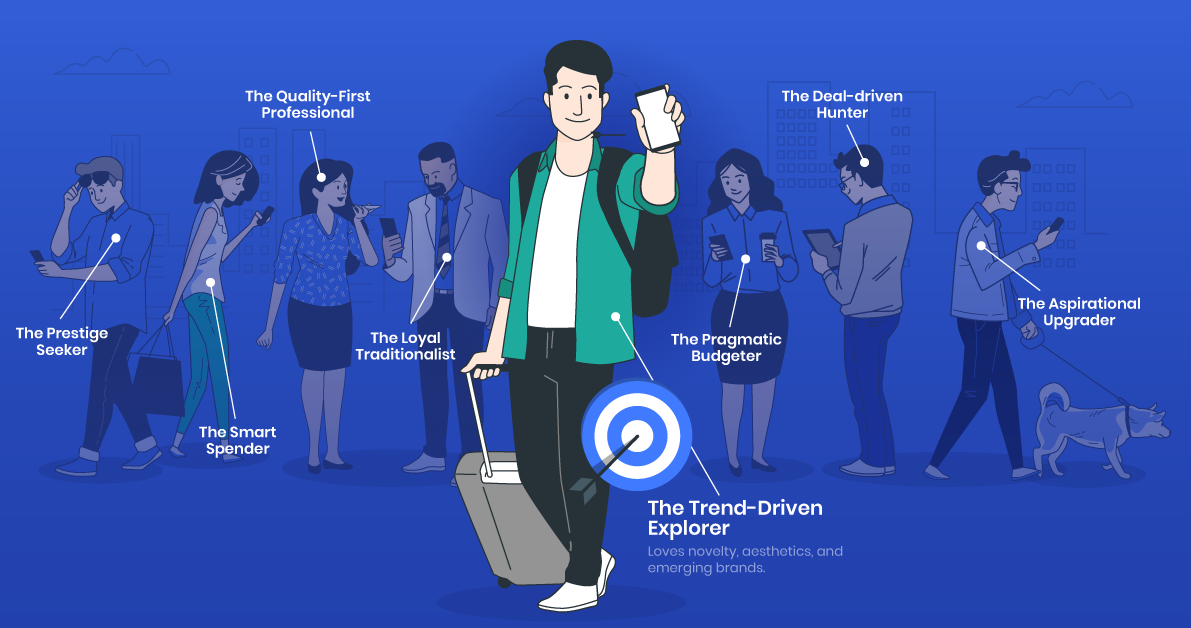
Let’s look at the candidate segmentation of consumers. The following table shows generally recognized consumer personas with summary descriptions, attributes, motivators and de-motivators.
Naturally the boundaries will be blurred between many of these segmentations in practice, but nonetheless it should generally be possible to map segmented B2C offerings against this matrix. This is the first step towards pitching the appropriate offer when a specific persona is identified visiting the website or otherwise engaging with the offerings.
Table 2: Persona profiles
| Persona | Brand sensitivity | Disposable Income | Value Consciousness | Motivations | Buying triggers | Barriers | |||
|---|---|---|---|---|---|---|---|---|---|
|
The Prestige Seeker Status-driven consumer who uses brands as identity signals. |
Very high | High | Low |
|
|
Anything perceived as "basic" or mass-market | |||
|
|||||||||
|
The Quality-First Professional Practical but willing to pay for proven performance. |
Moderate–high | High | Moderate |
|
|
Anything that feels gimmicky or untested | |||
|
|||||||||
|
The Smart Spender Wants the best performance-to-price ratio. |
Low-moderate | Moderate–high | High |
|
|
Over-priced premium products | |||
|
|||||||||
|
The Pragmatic Budgeter Focused on affordability and practicality. |
Low | Low-moderate | High |
|
|
Anything premium or feature-heavy | |||
|
|||||||||
|
The Trend-Driven Explorer Loves novelty, aesthetics, and emerging brands. |
Moderate | Moderate | Low-moderate |
|
|
Traditional or "boring" brands | |||
|
|||||||||
|
The Loyal Traditionalist Prefers familiar, trusted brands and avoids risk. |
High | Moderate | Moderate |
|
|
New or untested brands | |||
|
|||||||||
|
The Aspirational Upgrader Wants premium experiences but has limited budget. |
High | Low-moderate | Moderate |
|
|
High upfront cost | |||
|
|||||||||
|
The Deal-driven Hunter Price-first shopper who optimizes for savings. |
Very low | Low | Very high |
|
|
Anything full-price | |||
|
|||||||||
The next step is to create a mapping of personas to the device characteristics, so that candidate personas are identified for each set of possible device characteristics or buckets. In practice multiple personas are possible for most sets of device characteristics, but this still enables greatly improved matching of offers to personas.
Table 3: Mapping persona to device
| Model age | Brand | Premium | High tier | Mid tier | Low tier / entry level |
|---|---|---|---|---|---|
| <2 years | Mainstream |
|
|
|
|
| Emerging |
|
|
|
|
|
| 2 – 5 years | Mainstream |
|
|
|
|
| Emerging |
|
|
|
|
|
| >5 years | Mainstream |
|
|
|
|
| Emerging |
|
|
|
|
|
How this table may be used: for every visitor to a website, DeviceAtlas provides rich metadata on the device used. For mobile phones and tablets, the details available enable identification of the persona. Just three properties are required: year released, vendor, and hardware classification. Using these three as a lookup in the above table returns two candidate personas, per the below illustrative examples.
Example 1
Prestige Seeker / Quality-First Professional
User-Agent string of visitor
Dalvik/2.1.0 (Linux; U; Android 16; V2515 Build/BQ2A.250610.001-BP2A.250605.031.A3_V2032L87
This is identified by DeviceAtlas as the Vivo X300 family (model = V2515).
Key characteristics
| Brand: | Vivo (this may be considered to be an emerging brand, depending on country) |
| Year Released: | 2025 |
| Classification: | Premium (Score = 8787) |
Via a lookup in the above table, two candidate personas are returned: Prestige Seeker (innovation-driven), and Quality-First Professional. This information can be used to decide what offer to lead with, with appropriate messaging for the persona profile.
Example 2
Trend-driven Explorer / Smart Spender
User-Agent string of visitor
Mozilla/5.0 (Linux; Android 13; SC-55C) AppleWebKit/537.36 (KHTML, like Gecko) Chrome/109.0.0.0 Mobile Safari/537.36
This is identified by DeviceAtlas as the Samsung Galaxy Z Fold 4 (model = SC-55C).
Key characteristics
| Brand: | Samsung |
| Year Released: | 2022 |
| Classification: | High Tier (Score = 7792) |
As before, looking these up in table 3 yields two candidate personas: Trend-driven Explorer and Smart Spender.
Example 3
Smart Spender / Pragmatic Budgeter
User-Agent string of visitor
Dalvik/2.1.0 (Linux; U; Android 10; N30 Build/QP1A.190711.020)
This is identified by DeviceAtlas as the Doogee N30.
Key characteristics
| Brand: | Doogee |
| Year Released: | 2020 |
| Classification: | Mid Tier (Score = 5701) |
Again, looking these up in table 3 yields two candidate personas: Smart Spender and Pragmatic Budgeter. The offer and messaging will be materially different here; the motivators/ demotivators identified in table 2 can be used to design appropriate messaging to resonate with the persona profile.
Conclusion
Matching offers to first-time visitors no longer has to be a lottery; using non-PII signals available (HTTP headers), DeviceAtlas can be used to identify candidate personas based on the characteristics of the visitor device. This covers the proportion of traffic that is mobile users (phones and tablets); the reason for this is that desktop PCs do not enable identification and segmentation. For most businesses, mobile visitors represent 50-60% of their traffic.
By narrowing down the scope of possibilities, marketers are equipped to materially improve the likelihood of visitor engagement with their offerings. This is all achieved without any PII dependency or advance knowledge of the visitor; solely contextual signals. DeviceAtlas device intelligence is used by market leading organizations worldwide to deepen their insights into their visitors in real time, enabling them to outperform their competitors.