





There is a fundamental identity problem in CTV advertising. Pixalate’s Q3 2025 “Connected TV: Malformed & Fraudulent Bundle ID Risk Report” analyzed 1.7 billion CTV ad impressions across Roku, Amazon Fire TV, Samsung Smart TV, and LG Smart TV.
Pixalate found that 38% of CTV Bundle IDs were malformed, unidentified, or fraudulent across major platforms. A clear sign that CTV signal integrity is under significant strain. Pixalate’s report examines the challenge of using Bundle IDs to identify Connected TV (CTV) apps in open programmatic advertising. This misclassification impacts everyone involved in the open programmatic ecosystem from advertisers to demand-side platforms.
The consequence of unmapped Bundle IDs is serious: It can greatly reduce the accuracy of audience targeting and campaign reporting, indicate fraudulent activity and cause major revenue loss.
Pixalate’s Findings on Bundle IDs
CTV misidentification has become a systemic issue across the programmatic supply chain. A significant proportion of widely used detection libraries cannot reliably classify different hardware types, leading to major gaps in how impressions are interpreted.
Unlike traditional cable environments, CTV relies on internet connected devices serving ads through discrete applications. For platforms and for buyers, the central operational challenge is ensuring that both the device and the app are correctly identified, as this underpins targeting, reporting, and viewer understanding.
Bundle IDs (the identifiers that tell you which app an ad came from) are meant to be unique and traceable. Yet, in reality, they’re inconsistent, easily spoofed, and often unreliable. View the table below to see the level of inaccuracy of Bundle ID types across major CTV platforms.
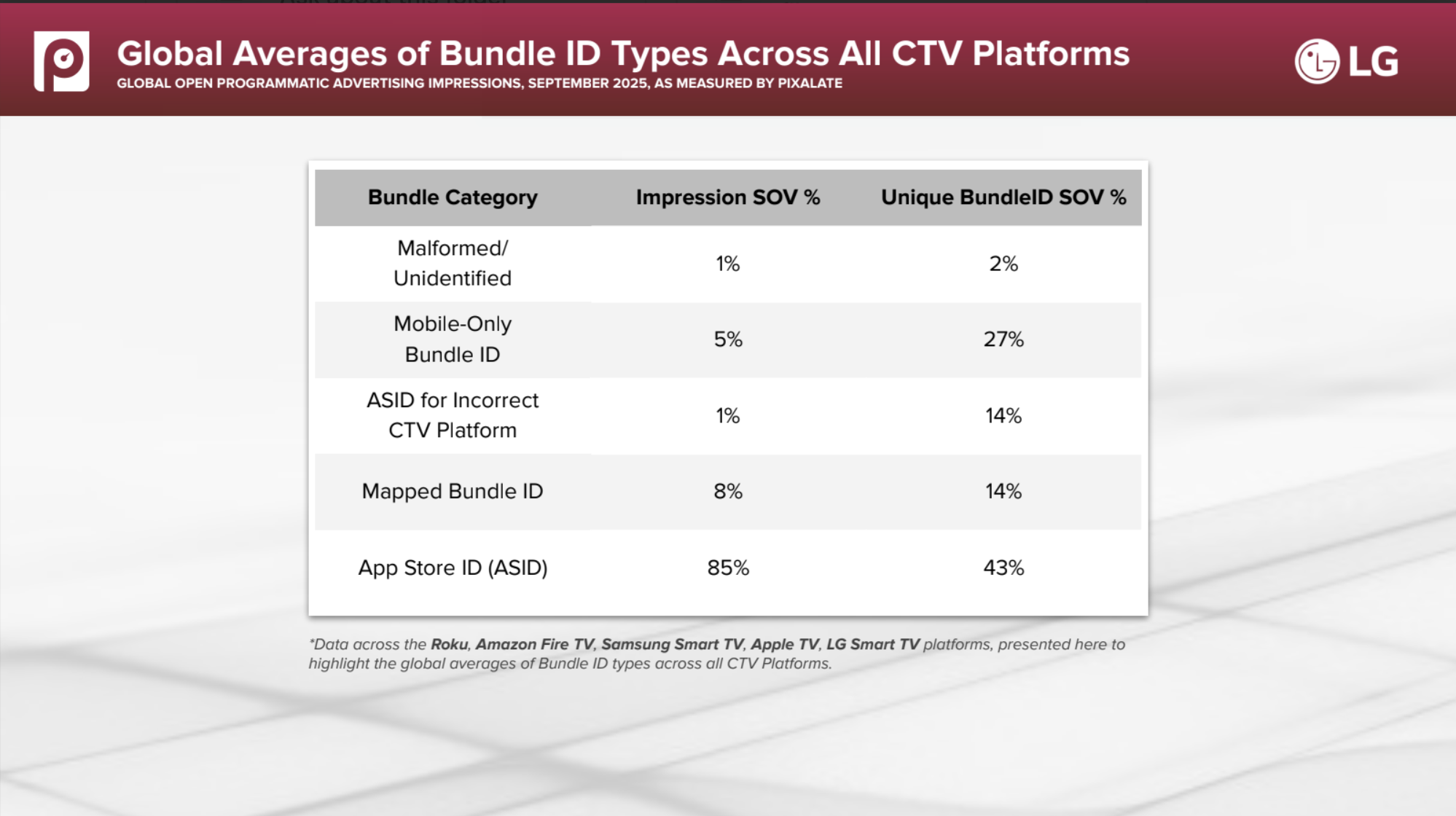
Image source: Pixalate
Pixalate’s data highlights significant variation in identifier quality across the four platforms:
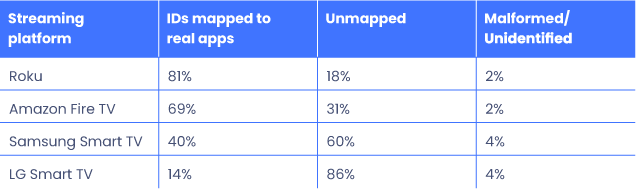
Roku presents the most stable CTV ecosystem, though it still contends with spoofing and mobile-only identifiers. Other platforms face more significant identity challenges. For example, nearly one in three Amazon Fire TV impressions use unverifiable identifiers, and LG Smart TV remains the most exposed, with the highest share of spoofed, malformed, or unmapped identifiers.

Image source: Pixalate
LG Smart TV had a startling 86% of impressions that weren’t reliably tied to a real app. This is an example of why the issue needs to be addressed by advertisers who are spending valuable money on campaigns that might be going to the incorrect audiences and viewers.
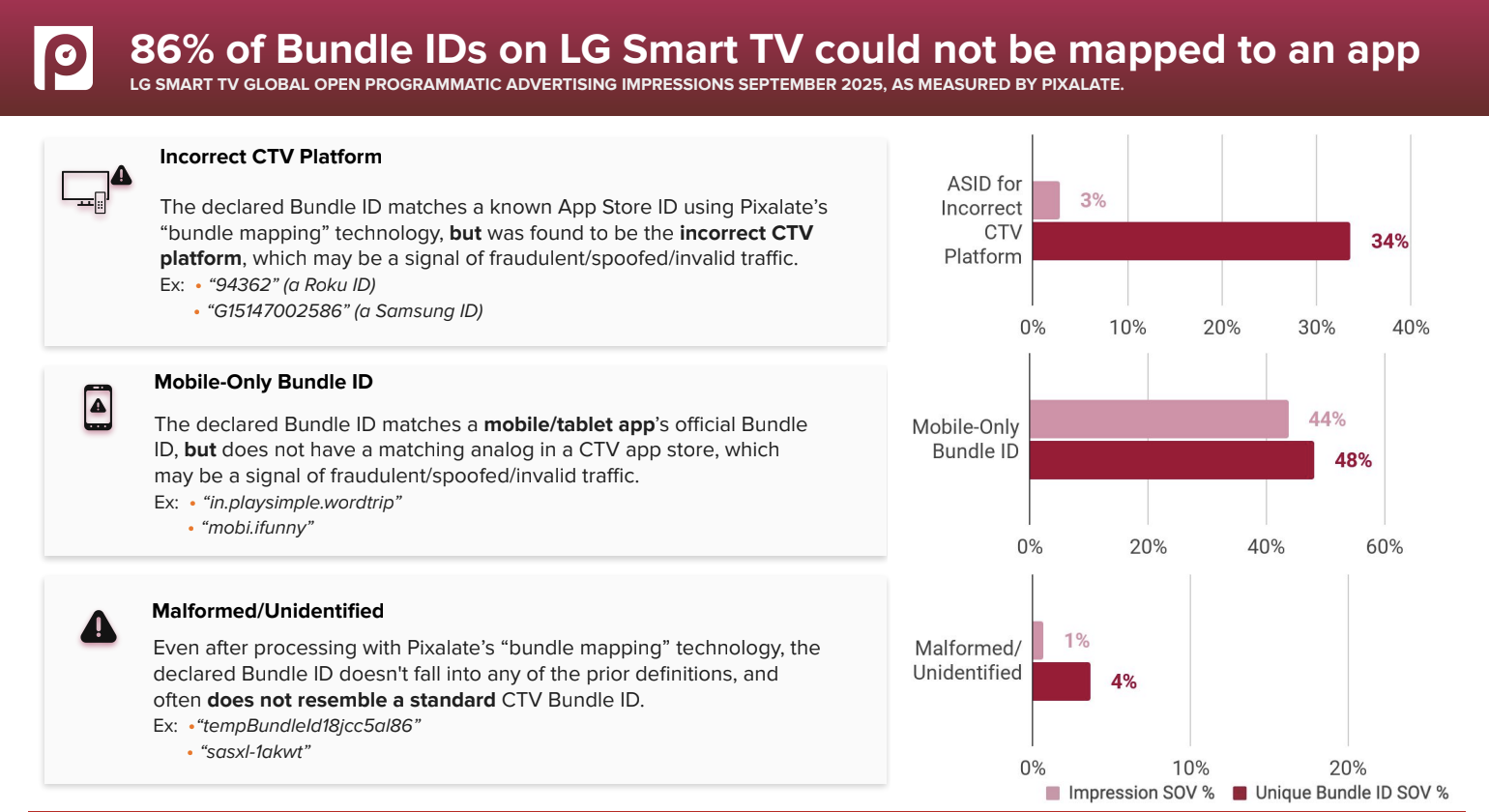
Image source: Pixalate
What This Means for AdTech
When Bundle IDs are incorrect or intentionally misleading, platforms, verification partners, and buyers encounter predictable and costly consequences such as:
- Inaccurate Ad Targeting: Serving the wrong ads and CTAs to different devices, impacts the ability to navigate users to desired conversions.
- Higher Fraud Risk: Spoofed apps can drain legitimate publishers’ budgets. Wrong-platform IDs make SSP/DSP/advertiser transparency unreliable.
- Loss of Potential Revenue: Variations in CTV Bundle IDs hinders advertisers ability to optimize ad campaigns. Ads sent to the wrong screen are less likely to convert.
- Unreliable Measurement & Reporting: Invalid identifiers distort app-level performance and audience segment accuracy.
- Poor User Experiences: Content and ads may not be optimized for the correct devices, leading to a frustrating experience for customers.
Therefore, without accurate IDs, AdTech platforms struggle to execute campaigns effectively and efficiently.
What This Means for Streaming
Like AdTech, streaming platforms are also affected by malfunctioning CTV Bundle IDs. When the ecosystem is flooded with malformed or spoofed identifiers, streaming providers can experience lost revenue and weaker market positioning.
Spoofed traffic can appear as other apps which damage brands’ reputation. For example, advertisers can blame platforms for poor performance when it is a fake ID which distorts perceived performance and essentially reduces trust.
Not only that, with a weak impression, buyers are less inclined to purchase ads on certain platforms. Platforms with unclear identity chains (e.g. LG) risk losing demand to cleaner ecosystems like Roku. Without verified IDs, advertisers can direct their ads to other platforms that are more accurately identified. Furthermore, reduced buyer confidence caused by misidentified platforms can lead to potential revenue loss.
To learn more about DeviceAtlas’ role in these industries, you can check out our solutions for streaming and AdTech companies.