


Awareness of the importance of sustainability has been steadily growing since it increasingly influences all areas of our lives. Designing for sustainability is now directly beneficial for businesses; with legislative changes in the EU and elsewhere, consumer awareness of the full lifecycle impact of what they buy is growing, including the impact on their own environmental footprint and energy bills.
Organizations which have an active Corporate Social Responsibility program or which are generally tuned into the wider landscape will likely already be seeking to adhere to best practices in this area. Those that aren’t can be expected to arrive there over time, either through dawning realization (voluntary) or market pressure and/or legislation (involuntary). Either of these may be accelerated by changing marketing conditions regarding energy costs.
In order to support the growing needs for wide-scale measurement and insights, DeviceAtlas has introduced a new property category “Sustainability” under which a range of properties will be added progressively. The first round of new properties covers the area of power consumption across phones, tablets, and TVs. Subsequent rounds of new properties in the Sustainability category will cover areas such as repairability and survivability, which measure other aspects of the environmental footprint over the device lifecycle.
The purpose of the properties is to assist organizations to deepen their understanding of full lifecycle sustainability aspects and meet current and emerging legislative requirements such as the EU’s Corporate Sustainability Reporting Directive (CSRD) and Ecodesign for Sustainable Products Regulation (ESPR) respectively.
The New Sustainability Category
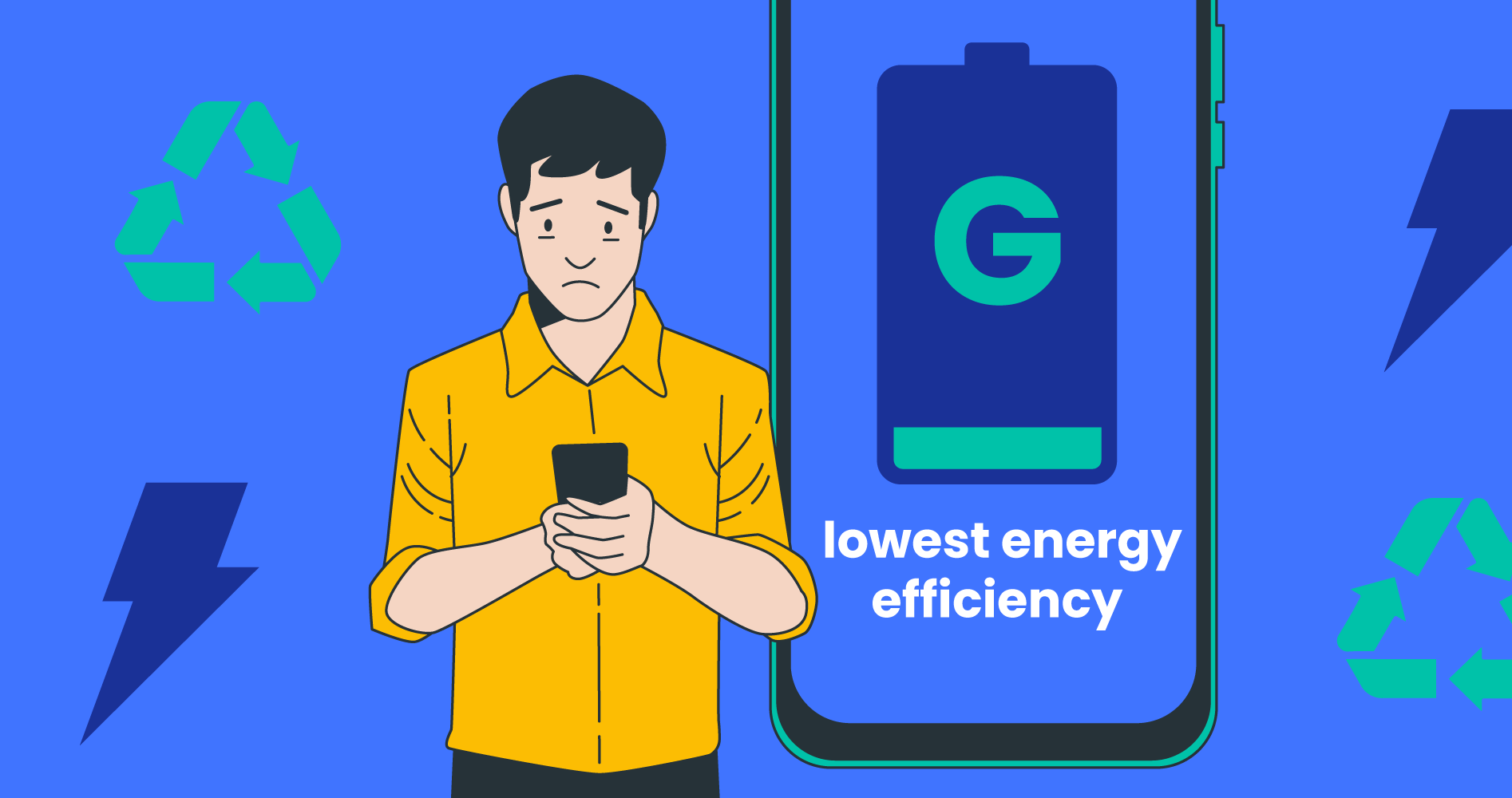
The first set of properties focuses on energy efficiency and power consumption across key device types, e.g. mobile phones, tablets, and TVs. See below for the names and descriptions of each property.
Mobile phone and tablet properties
For mobile devices, most of the focus is on battery aspects since these have a considerable environmental footprint. In general, devices with batteries are already optimized to minimize power consumption, because battery duration is a key selling point for the consumer.
| Property Name | Description |
|---|---|
| Energy efficiency class | Ranking of energy efficiency from A (most efficient) to G (least efficient) |
| Battery technology | Chemical technology of the battery |
| Rated battery capacity | Battery capacity in mAh |
| Battery endurance per cycle | Average device usage time for fully charged battery |
| Battery endurance in cycles | Lifetime number of charge/discharge cycles for the battery |
| User-replaceable battery | Battery can be replaced by consumer |
| Charger output power | Required output power from charger |
TV properties
Key selling points for TVs typically include brightness and screen size; both of these are strongly correlated with power consumption. Hence the manufacturers have a perverse incentive, unlike that which exists for battery-powered devices. Accordingly, legislation and monitoring regarding TVs is more important for the ecosystem from an energy perspective. (Set against this, batteries are high impact on the ecosystem in other ways).
| Property Name | Description |
|---|---|
| Energy class SDR | Energy efficiency class for Standard Dynamic Range (SDR) - TV only |
| Power usage SDR (on) | On-mode power demand in Standard Dynamic Range (SDR)- TV only |
| Energy class HDR | Energy efficiency class for High Dynamic Range (HDR), if implemented - TV only |
| Power usage HDR (on) | On-mode power demand in High Dynamic Range (HDR) - TV only |
| Power usage (off) | Off-mode power demand - TV only |
| Power usage (standby) | Standby mode power demand - TV only |
| Power usage (networked standby) | Networked standby mode power demand - TV only |
Example analyses and use cases enabled by DeviceAtlas:
- Measurement of battery technology adoption over time
- Correlations between battery technology and hardware classification
- Distribution of energy ratings by release year (measurement of effectiveness of legislation)
- Evolution in power consumption patterns over time
- Lifetime carbon footprint measurement of a content item or stream based on energy consumption of endpoints accessing the item or stream
- Customer analytics enrichment by service providers - what are the sustainability patterns of downstream users?
- Measurement of environmental footprint by brands – which brands are most sustainability-conscious?
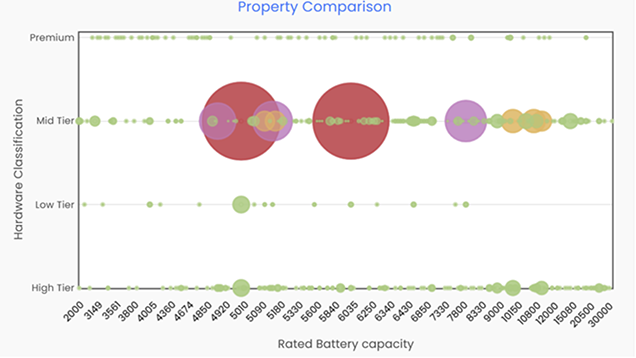
As an example analysis, the below graph shows the distribution of battery capacities across hardware classifications. For mid-tier devices, the most common battery capacities are 5,000 and 6,000 mAh; but somewhat unexpectedly, premium devices have widely varying battery capacities, with no obvious pattern. This variance may be a consequence of lower price sensitivity permitting flexibility to select capacities that are not in mass production to the same degree as those used by mainstream devices.
Source: DeviceAtlas Data Explorer
Conclusion
With sustainability becoming increasingly important, organizations are coming under increasing pressure to improve the lifetime environmental impact of their products and services. DeviceAtlas provides intelligence on device capabilities to diverse verticals, including government regulators, analytics platforms, retailers, mobile operators, video streaming platforms, many of which can significantly influence the carbon footprint of their end customers through improvements to their products and services. By introducing the new Sustainability property category, DeviceAtlas enables its customers to influence and educate their stakeholders, partners, customers and end users regarding the effective environmental footprint of their services, and plan their evolution accordingly.
AcknowledgementDeviceAtlas is grateful to the EU EPREL initiative (European Product Registry for Energy Labelling) for the licensing rights they have granted.